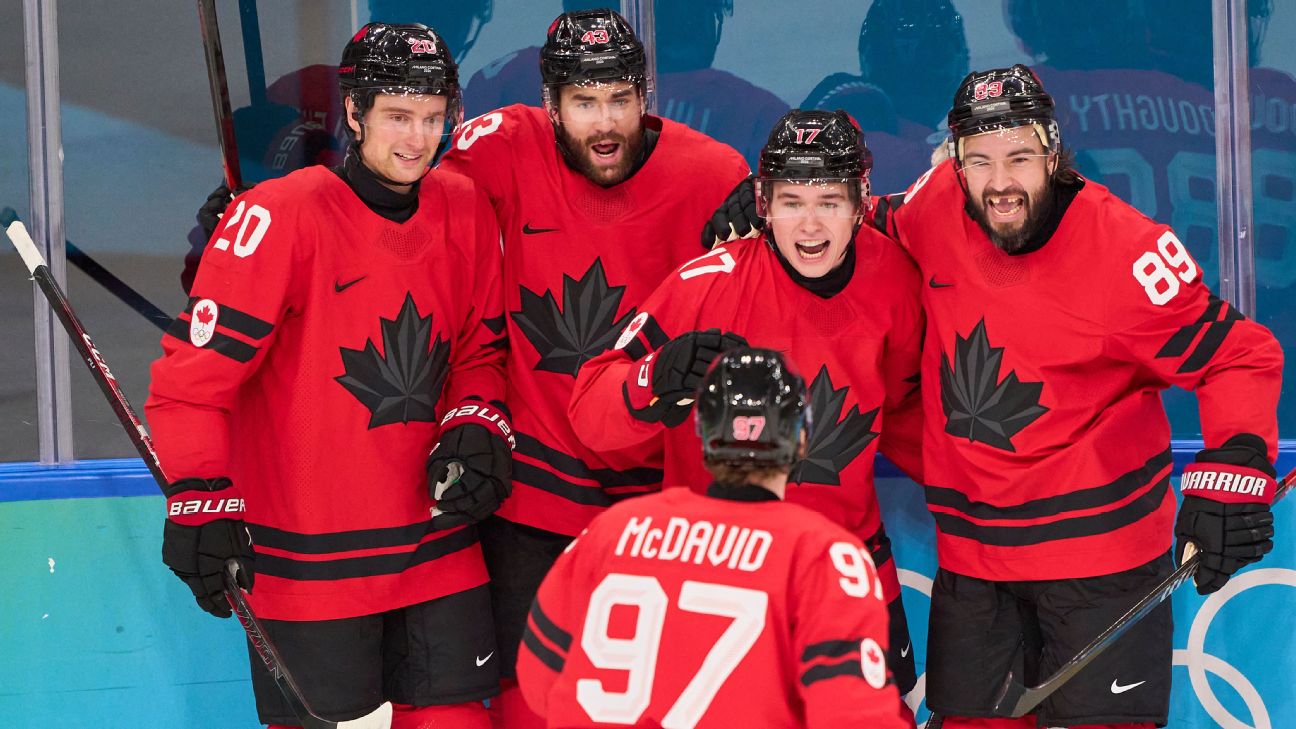
The race for men’s hockey medals at the 2026 Milan-Cortina Winter Olympics is down to four nations, with Canada, Finland, the United States and Slovakia vying for a place on the podium. Two semifinal matchups will determine who advances to the gold-medal game and who will play for bronze.
In one semifinal, Canada faces Finland in a clash between two countries with deep Olympic and international hockey pedigrees. Canada traditionally leans on a fast, physical style, supported by depth across all four lines and mobile defensemen capable of joining the rush. Finland, meanwhile, is known for structured play, strong goaltending and disciplined defensive systems that can frustrate even the most talented opponents.
The Canadian approach typically emphasizes pace through the neutral zone and pressure on opposing defenders. Expect Canada to try to establish an early forecheck, generate traffic in front of the Finnish net and rely on quick puck movement on the power play. Special teams often prove decisive in knockout games, and Canada’s ability to capitalize on man-advantage chances or kill penalties efficiently could shape the outcome.
Finland’s success often stems from cohesive team defense and smart positional play. The Finns are comfortable in tight, low-scoring contests and are adept at protecting leads late in games. They are likely to prioritize limiting odd-man rushes against, blocking shots and relying on their goaltender to handle high-quality chances. On offense, Finland tends to strike through counterattacks and well-executed set plays in the offensive zone.
In the other semifinal, the United States meets Slovakia. The U.S. program frequently blends speed, skill and versatility, with forwards capable of playing in multiple roles and defenders contributing offensively. Quick transitions from defense to offense are often a hallmark of American teams, as is aggressive pursuit of the puck in all three zones.
Slovakia enters as a resilient opponent, traditionally combining hard work with opportunistic scoring. Slovak teams often lean on a strong work ethic, sturdy defensive structure and timely offense. In this matchup, Slovakia is likely to focus on staying compact in their own zone, winning battles along the boards and turning defensive stops into counterattacks. Their goaltending and ability to manage momentum swings will be key factors.
Both semifinals carry significant stakes beyond the immediate prospect of a medal. For Canada and Finland, another deep Olympic run would reinforce their long-standing reputations as powerhouses in international hockey. For the United States, a place in the gold-medal game would underscore the continued growth and depth of the American talent pool. Slovakia has an opportunity to further elevate its standing on the world stage with a strong performance against a traditionally deep U.S. lineup.
As play unfolds, the critical storylines will center on goaltending, discipline and execution in key moments. A single power-play goal, a crucial penalty kill or a standout individual effort could swing either game. With only four teams left in contention, every shift, line change and tactical adjustment will be magnified as Canada, Finland, the United States and Slovakia skate for a chance at Olympic gold.