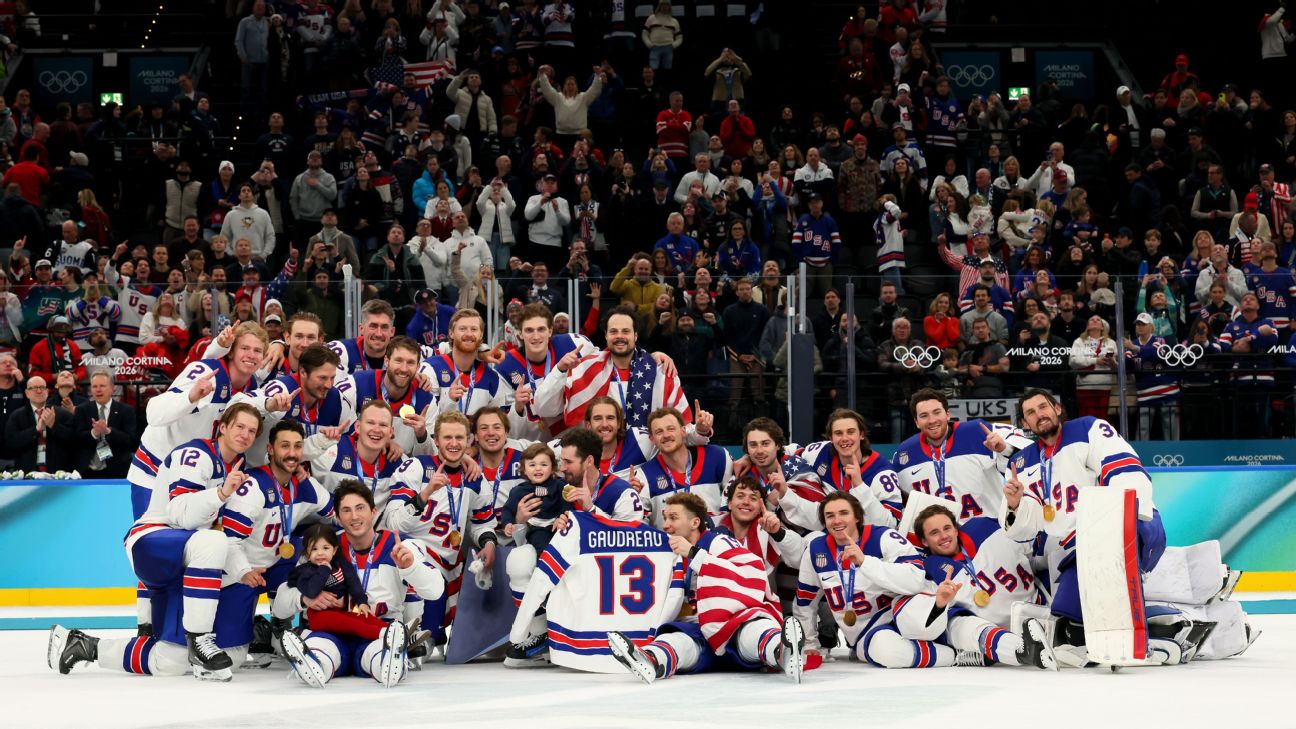
Team USA secured a memorable Olympic men’s hockey gold medal with an overtime victory against Canada, capped by Jack Hughes’ decisive goal. The game delivered the intensity and balance expected whenever these two rivals meet, with momentum shifting throughout before a single play in extra time settled the outcome.
From the opening faceoff, both teams leaned on their strengths: Canada relied on structured pressure and physical play, while the United States emphasized speed, transition, and puck movement through the neutral zone. Early on, Canada established a territorial edge with sustained shifts in the offensive zone, forcing the American defense to manage traffic in front of the net and clear second chances.
Team USA gradually found its rhythm by tightening its gap control and exiting the defensive zone with cleaner, shorter passes. Those adjustments allowed the American forwards to attack with more pace, creating odd-man rushes and forcing Canada’s defense to pivot and defend on the back foot. The United States also made better use of its defensemen joining the rush, stretching Canada’s coverage and generating shooting lanes from the blue line.
Special teams played a crucial role in keeping the game tight. Both penalty-kill units were disciplined and aggressive, limiting high-danger opportunities and steering shots to the outside. When either side did manage to set up on the power play, goaltending proved to be the difference-maker, as each netminder responded with timely saves to preserve the deadlock.
In the third period, the tension rose with every shift. Canada tried to establish a heavier forecheck, cycling the puck down low and looking for screens and deflections. The United States countered by staying compact in the defensive zone and transitioning quickly whenever a turnover presented itself. Neither side could find the winner in regulation, sending the gold medal game to sudden-death overtime.
The winning sequence for Team USA came from a combination of patience, support, and execution. In overtime, the Americans maintained possession under pressure, using quick, controlled passes to avoid turnovers in dangerous areas. Hughes found a pocket of space, received the puck in stride, and took advantage of a brief defensive lapse. With the Canadian coverage momentarily spread, he created his own shooting lane and finished the chance, ending a tightly contested game with one precise play.
Hughes’ overtime goal was the final moment of a matchup defined by small margins. Canada’s structured approach, strong forecheck, and committed backchecking kept the game within reach at all times, while Team USA’s speed, transition game, and poise under pressure allowed it to steadily generate quality chances. Goaltending on both sides anchored their respective efforts, turning the contest into a true test of patience and execution.
Ultimately, the difference came in overtime, where one sequence of controlled possession and one decisive shot gave Team USA the edge. The result capped a gold medal game that showcased the best elements of international hockey: high skill, disciplined systems, resilience on both benches, and a single moment of brilliance to settle a championship.